

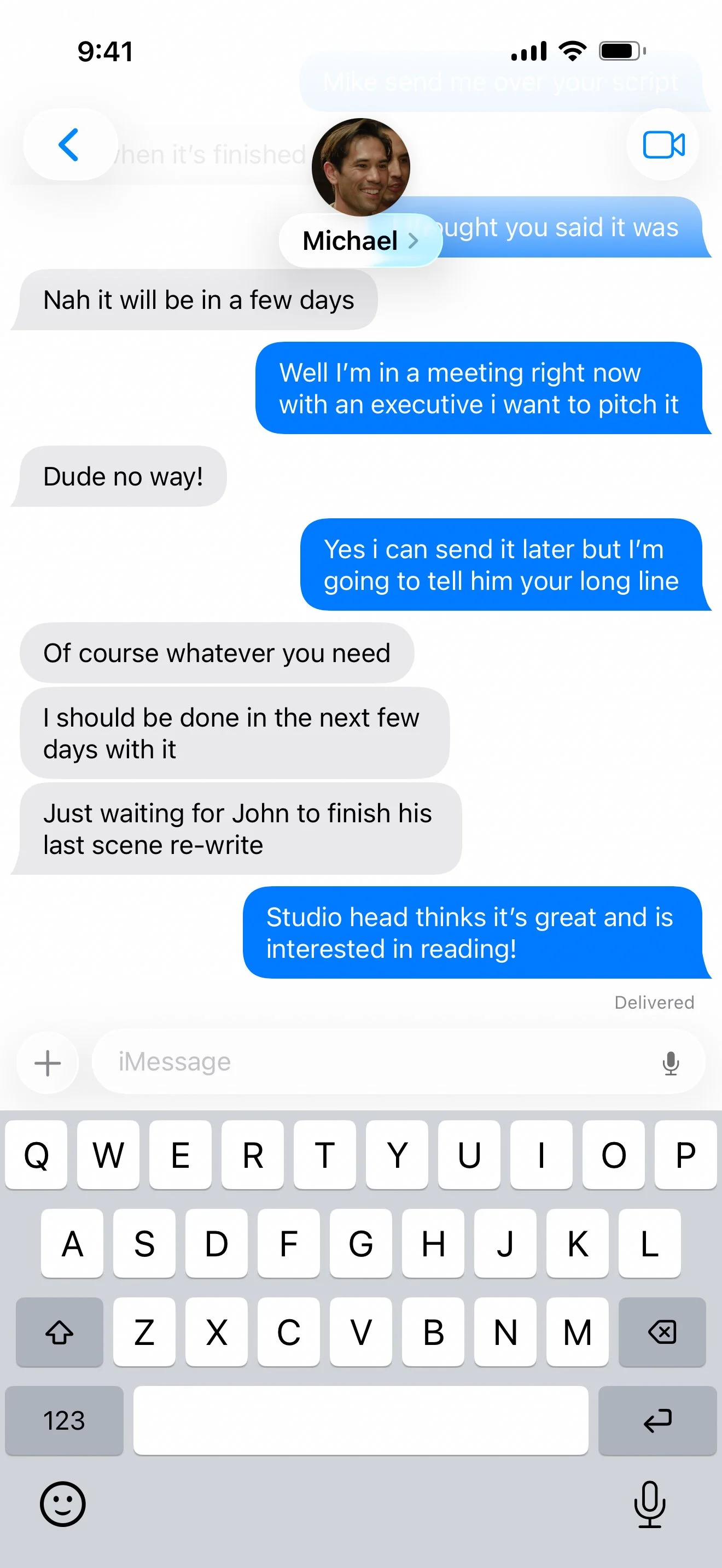
Prop Messages Live Type Mode
There's a moment on every modern film set that nobody warns you about in film school. The scene is lit, the actor is ready, the camera is rolling — and then a phone has to do something. Ring on cue. Show a text at the exact beat of a line. Play a video call with someone who isn't there.
And suddenly forty people are waiting on a six-inch piece of glass.
I've been on sets where we burned 30 minutes because a real iPhone wouldn't cooperate. A notification from the actor's actual life popped over the scripted text. The screen auto-locked between takes. The "incoming call" was a crew member in the parking lot dialing on cue, and the cell service dropped. Every filmmaker who's shot a phone insert has a version of this story.
That's the problem a Prop Screen solves — and it's a much deeper craft than it looks.
What is a prop screen, exactly?
A prop screen is a phone (or tablet soon) display that's performing, not functioning. It looks like a real lock screen, a real messages thread, a real incoming call — but every pixel is staged: the contact name is the character's, the message history is the script, the battery percentage matches the last take, and the "incoming call" fires exactly when the director wants it, take after take.
Which is why phone screens in low-budget films are so often shot "for real" and fixed in post with screen replacement — another few hundred dollars per shot, and a VFX artist quietly cursing the actor's thumb over the display.
The Two ways screens betray you on set
1. Timing. Real phones don't take direction. A real text arrives when a nervous PA hits send, not on the actor's line. A prop screen plays the conversation like a piece of blocking — the incoming message lands after the look, the typing bubble holds through the pause, the reply sends when the actor actually taps.
2. Continuity. Shoot coverage across a day, and the real phone's clock marches from 9 AM to 7 PM while the scene takes place over ninety seconds. Script supervisors have gone gray over battery percentages. On a prop screen, it's 9:41 with 85% battery in every setup, forever.
The details that sell the shot
What separates a convincing prop screen from a cheesy one is a hundred small things audiences never consciously see. The typing speed — a real person types about eight characters a second, and anything faster reads as fake. The pause before a reply. The "Delivered" that appears under a sent bubble a half-beat late. The keyboard that's already up when the scene starts mid-conversation. The signal bars that flicker out on cue when the script says the call drops.
And language: if your character is in São Paulo, her phone shouldn't say "Delivered" — it should say "Entregue," and her keyboard shouldn't be a US QWERTY. The phone is a costume. It has to be dressed for the character, not for the crew.
Where Prop Screen came from
This is the part where I tell you we got tired of solving this problem one workaround at a time. Prop Screen is an iPhone and iPad app we built at Game Night Films & Film Swag — working filmmakers, between our own shoots — to be the playback department that fits in a jacket pocket.
It stages the scenarios indie sets actually shoot: scripted message conversations that play out in real time or respond to the actor's real typing, incoming and outgoing calls triggered by a volume button (or by a second phone in a director's hand), video calls that blend a pre-recorded caller with the live front camera, notifications that land on cue over a lock screen.
We use it on our own productions first. Every feature exists because a shoot demanded it.
A note on finding us
If you searched PropScreen.com looking for the app — that domain isn't us. You'll find Prop Screen on the App Store, and everything about the app lives here on our site at FilmSwagStore.com. Bookmark this one.
FAQ
What is a prop screen in film? A prop screen is a staged phone or tablet display used on camera — fake calls, texts, and apps that perform on cue, stay consistent between takes, and avoid trademarked interface designs.
Is it legal to show real apps in a film? Real app interfaces are protected trade dress, so productions typically use legally distinct recreations. Final clearance always rests with your production's legal team — but starting from a design built to be distinct beats fixing it in post.
How do actors trigger a prop screen without the audience noticing? The cleanest methods are a volume-button press (invisible in hand), a timed delay, or a second phone operated by the director(coming soon) — all of which beat asking an actor to hit a tiny on-screen button mid-performance.
Do I still need screen replacement VFX? For most dialogue-driven phone shots, no — if the screen performs correctly in camera, you keep the actor's real reflections, real finger contact, and real light, which is exactly what VFX screen replacement struggles to recreate.
Nick Mahar is a filmmaker at Game Night Films. Prop Screen is available for iPhone and iPad on the App Store.